
Why Community (the AI Edition)
Woven together from some loose ideas and an abstraction laddering exercise in the Swiss lounge on my way to London for Community Week.

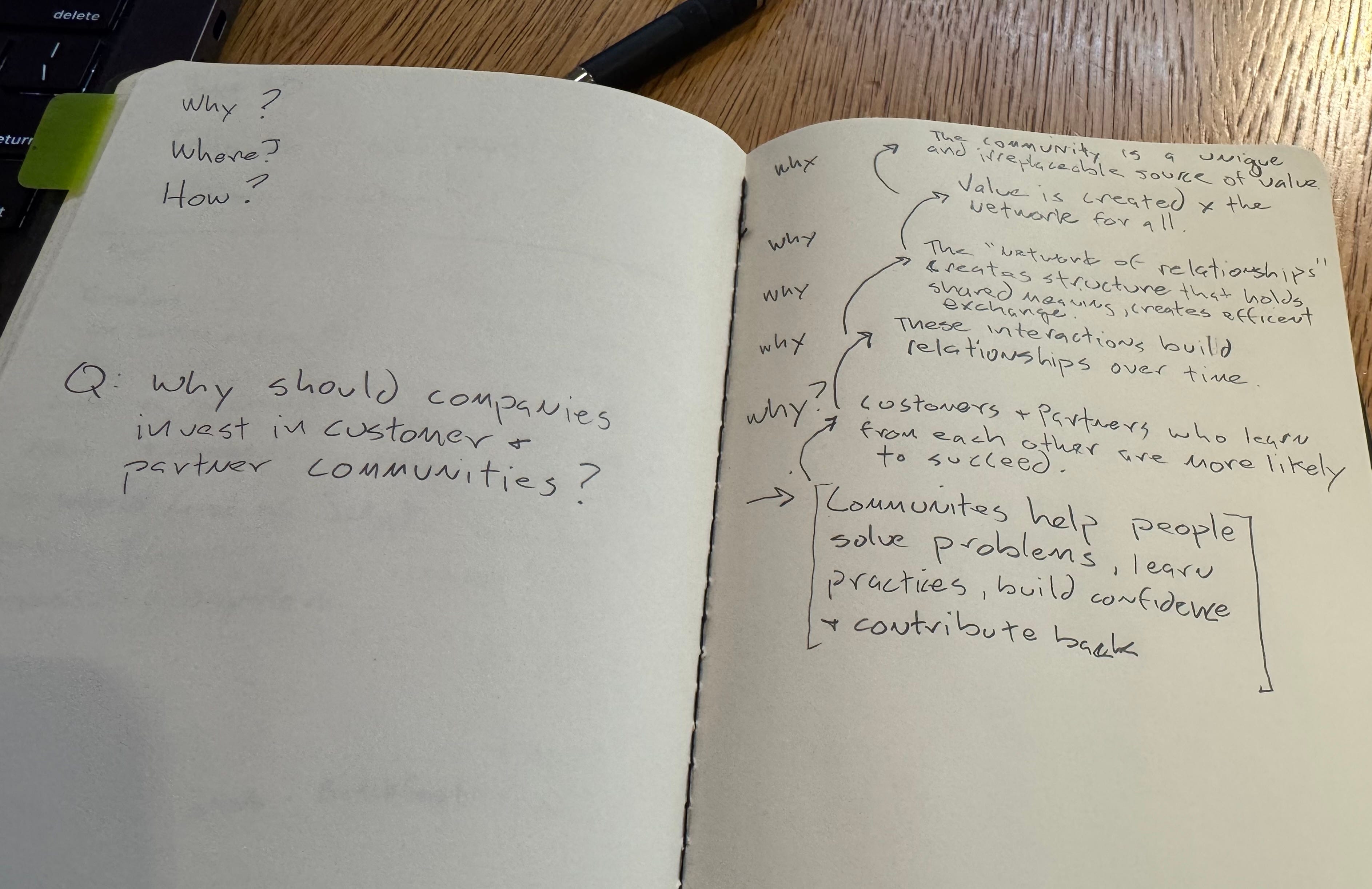
Ask a room full of executives why the business should invest in the community, and if you aren’t escorted out, you will get at least as many answers as there are people.
That is not necessarily a failure of the room, but rather a reflection of the subject's complex nature. Community investment is a full-contact sport: many stakeholders, competing priorities, real budget, and no shared vision, at least not one that lasts more than 3-4 years. Everyone wants to jump to what (the vision), where (the ecosystem), and how (the programs). Almost nobody stops to settle why. So the why never gets settled, and every initiative that follows winds up relitigating it. The “why” question keeps coming back because it is never actually answered.
So let’s try to answer it.
The familiar case is: Customers solve problems, learn from peers, find working examples, and get more out of what they already bought. Partners learn faster and see where they fit. Fine. But look at how most companies build on that truth. A dozen small programs chasing small groups for narrow outcomes. Three teams all touching the same customer or the same partner, none of them holding the whole relationship. Efficient? Strategic? It is neither. It is a bag of tactics masquerading as a strategy.
The usual critique is that companies get stuck measuring engagement, but that’s not quite right. Plenty of smart people already know measurements that would be classified as “engagement” only tell part of the story. The real problem is they do not know what to measure instead. The methods and the math for it are still emerging, so teams count what is easy to count. But the thing worth counting is whether the relationships around the business are becoming an asset with real, accruing value, over time.
Now the “why” question is urgent. AI is turbo-charging the fast layers of the business: content, commerce, transactions, the surface churn. Stewart Brand’s pace layers are a helpful tool here, especially the idea (simplified for our purposes) that the fast parts learn, the slow parts remember. Community is a slow layer, where trust and memory accumulate over years. Customers used to start at your website, or at least somewhere in your digital ecosystem. Now they find out about you in places you don’t own or even necessarily influence.

The reflex is to throw more content at the problem. The problem is that everyone now has access to an infinite content machine that can spray as much competent but forgettable content anywhere they wish. Information is no longer a scarce resource. Treating your customers and partners as raw material to feed the machine never ends well. We are all living through a shared social media hangover, and people are genuinely pushing back on being used by a tool instead of being in the role of tool user.
A key distinction: you cannot separate knowledge from the knower. Information sits in a database. Knowledge lives in a person, with all their scars, lived experiences, and idiosyncracies. A model can retrieve the information. What it cannot hand you is the tacit knowledge (Polanyi’s phrase, “we know more than we can tell”) of someone who already hit the exact wall you are about to hit, at a company like yours, under the same pressure.
This idea first clicked for me shortly after we launched TechRepublic.com in 1999. We had one of our first posts in a Windows server forum, which was an incredibly complex permissions issue. Within 12 hours, 2 other members from different parts of the world offered up parts of a solution that helped the original poster solve the problem. It occurred to me that we had helped bring together the few people in the world who had encountered this particular problem and could solve it.
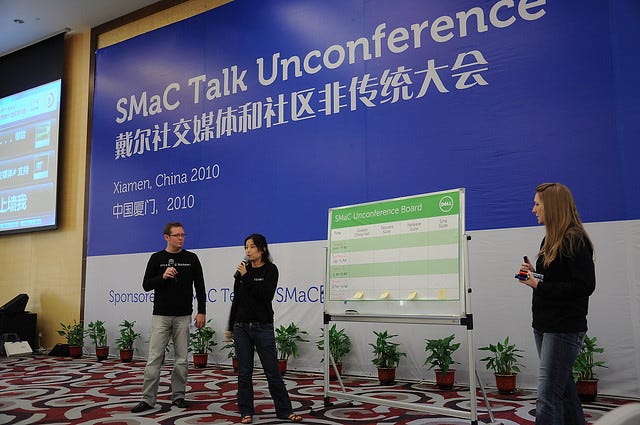
I saw this happen at global scale with our extended team members at Dell in late 2010. Part of our SMaC (Social Media and Community) team’s mission was to train and enable any customer-facing employee to interact on our communities and social media ecosystem. Globally. As part of the training process, we hosted global Unconferences with no predefined agenda that allowed thousands of Dell employees to come together to share their real experiences, issues, and advice. Beyond static training modules, these Unconferences created a community of practice that lived on long beyond the events.
Here is the thing I see missing from most strategy discussions: the best communities advance people. Professionally, in their craft and their careers, and personally, in who they are becoming. That is the part no library and no model reproduces, because it is not information moving around. It is people developing. Wendell Berry’s word for this concept is membership: not a list you join, but a web of people who show up for each other.
So the asset was never just a platform, program, or group. It is the network of relationships the organization has made possible. Everything the CFO likes (retention, expansion, advocacy, product signal) is an outcome of those relationships being made stronger.
That changes what you measure. The trap is to reach for whatever is easy to count, which is almost always a transaction: tickets deflected, leads sourced, seats renewed. This approach measures the exhaust, not the engine performance. Instead, explore: are people developing, moving from the edge inward, from newcomer to contributor to the one others turn to? Is value moving sideways between members, or does it all still route through you? That is what an appreciating relationship looks like from the outside, over a longer time horizon than this quarter’s dashboard. The methods for measuring it well are still maturing, but IMHO, the direction is not in doubt.
I see two future roads from here. One treats community as a content supply chain for the machine, for search and marketing automation. The other treats it as a relationship system (layer/infrastructure/substrate) that helps people make better decisions and build things together. Relationships are the rare asset that appreciates and is somewhat portable. When your champion changes jobs, the relationship goes with her. The person and related relationships are the asset. The sold seat of software is the transaction.
That is the why. Or at least, my current thinking on it.
Everything else is what, where, and how.
Thank you for explaining so professionally and technical community and how you actually made it such an important part in your project! I really think people hate slow process but some of them, like community, will make huge differences in the long run