

We’ve been sleepwalking through community strategy for a decade.
While executives write checks for “community initiatives,” most organizations are still running the same tired playbook: pick a platform, hire a community manager, count the likes, hope for magic. The defaults have become so ingrained that we’ve stopped questioning whether they actually work.
They don’t.
I’ve spent 25 years building communities for companies like Autodesk, Dell, IBM, and Fast Company. I’ve watched the rise and decline of social platforms. I’ve seen millions invested in community theater that delivers no strategic value. And I’ve seen what happens when you reject the defaults and actually design community as a strategic system.
The difference is profound.
The Default Trap
Here’s what default thinking has historically looked like:
Platform-first planning. Teams chose an Enterprise “default” platform like Khoros, or before asking what relationships they’re trying to build. The tool becomes the strategy.
Activity metrics over value creation. They count posts and members while ignoring whether any of it connects to business outcomes.
Community as a cost center. It is sequestered in support, disconnected from other customer-facing functions like sales, marketing, and customer success.
Short-term thinking over long-term relationships. Quarter-focused initiatives for relationships that last years.
These defaults exist because they’re easy. They’re what vendors sell. They’re what conferences and gurus teach. They’re what your competitors are doing.
They’re also why most community strategies fail.
Community as Strategic Architecture
Real community strategy starts with a completely different mindset: community is relationship-building infrastructure, not a marketing channel.
Think about your most valuable customer relationships. They don’t live in a single platform or program. They exist across an ecosystem of events, networks, advisory boards, user groups, and certification programs. Strong relationships create compound value over time. They reduce support costs. They accelerate product adoption. They generate referrals. They provide market intelligence.
But only if you design for it.
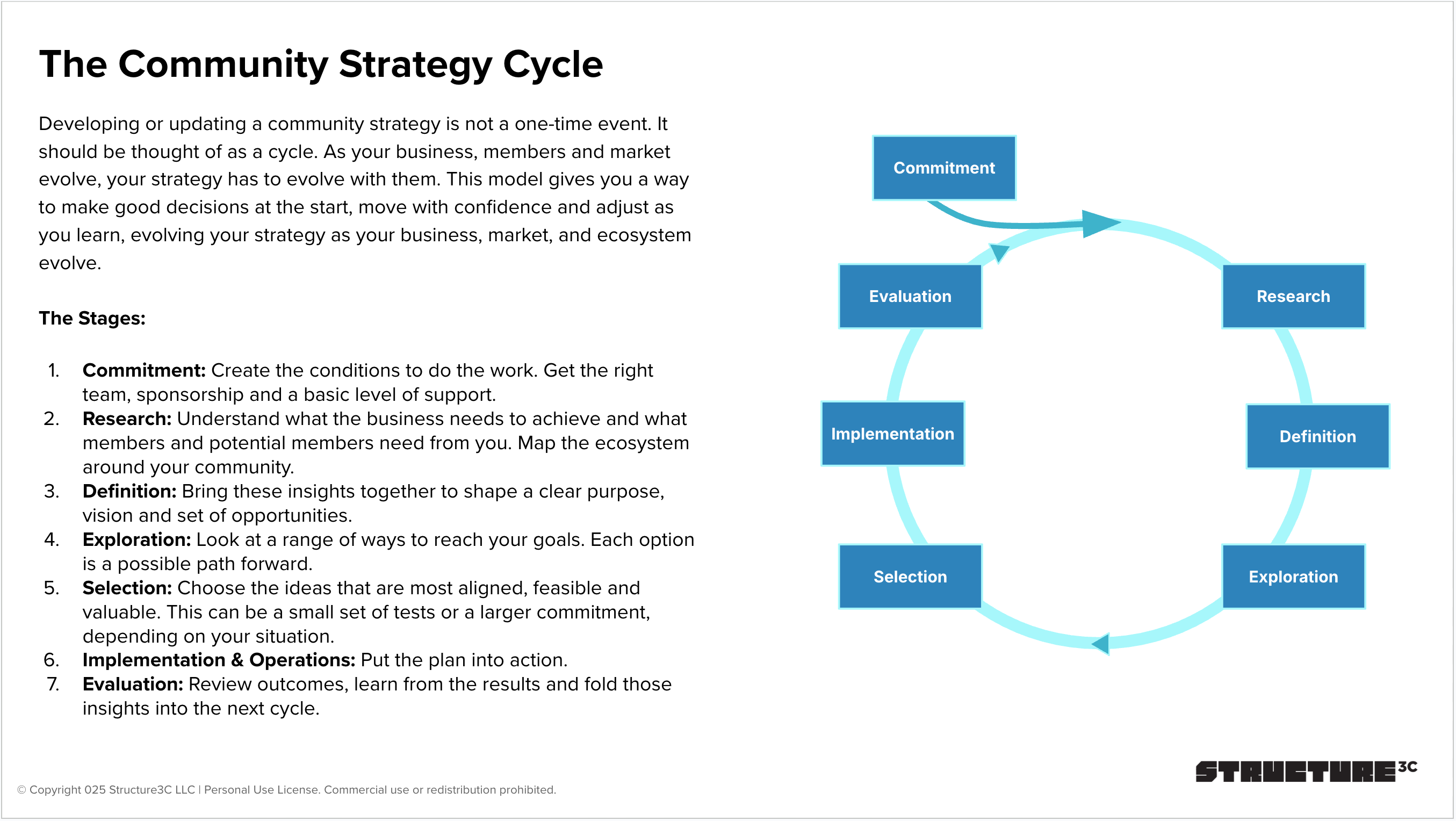
The Essential Community Strategy Framework treats community as a strategic architecture that requires the same rigor as product development or go-to-market strategy. It’s built on seven stages that move from insight to action:
Commitment – Not just budget, but organizational alignment. The right sponsors, stakeholders, and structure to do meaningful work.
Research – Deep understanding of member needs, ecosystem dynamics, and value exchange. Not surveys, but actual insight into how relationships create value.
Definition – Clear purpose and vision that aligns member value with business value. No generic mission statements.
Exploration – Opening the aperture to see the full range of possibilities. Looking beyond the platform to the ecosystem.
Selection – Choosing programs based on strategic value, not tactical convenience. Building a portfolio, not a feature list.
Implementation – Operating model that enables distributed execution with a centralized strategy. A Community Center and Programs Office structure that scales.
Evaluation – Qualitative signals at the macro level, quantitative metrics at the program level. Learning loops, not just dashboards.
Why a Design Approach is Essential
Three forces are converging that make this the moment to rethink community strategy:
Social platforms are collapsing. The spaces where we built communities are fragmenting. Twitter/X is unrecognizable. Facebook groups are ghost towns. LinkedIn is a content mill. Your members are looking for something better.
Ecosystem thinking is ascending. The smartest companies recognize that value creation happens across networks, not within silos. Community is how you activate and orchestrate ecosystem relationships.
AI makes community more valuable, not less. As content becomes commodified, authentic human relationships become the differentiator. Community provides the context, trust, and feedback loops that AI cannot. And community will become one of the most valuable sources of primary data for companies.
The companies that recognize this shift will build sustainable competitive advantage through their community ecosystems. The ones that don’t will keep funding failed initiatives and wondering why their NPS scores keep dropping.
From Default to Design
I developed this framework through hundreds of strategy engagements, watching what actually works versus what we think should work. It’s been pressure-tested with enterprise software companies, membership organizations, and platform businesses.
The organizations that succeed with it share three characteristics:
They reject the premise that community is a nice-to-have. They see it as strategic architecture for customer relationships.
They commit to the full cycle, not just the fun parts. Research isn’t optional. Governance isn’t an afterthought. Measurement isn’t just vanity metrics.
They build for the long term. Community strategy is a practice, not a project. It evolves as your business, market, and ecosystem evolve.
The Choice
You can keep running on defaults. Keep funding platforms that don’t deliver value. Keep wondering why your community initiatives fail to move the needle.
Or you can design something better.
The Essential Community Strategy Framework gives you and your team a structured approach to move from default thinking to intentional design. To build community ecosystems that create compound value over time. To transform community from cost center to strategic asset.
The framework deck is available here. It includes templates, worksheets, and tools to guide your team through each stage.
But more importantly, it includes a different way of thinking about community. One that treats relationships as infrastructure worth designing, not accidents worth hoping for.
Your customers are looking for meaningful connections. Your business needs sustainable differentiation.
It’s time to stop accepting defaults and start designing for what’s actually possible.
Bill Johnston is Founder & Community Architect at Structure3C. Over the past 25 years, he has designed community strategies for Autodesk, Dell, IBM, Fast Company, and dozens of other organizations. He works with leadership teams to build community as strategic infrastructure, not tactical add-ons.