


I’ve spent most of my career in the space between companies and their customers. Building communities, designing collaboration programs, and advocating for investing in long-term relationships.
So I know what it looks like when it goes wrong.
Someone gets excited about “engaging customers in innovation.” They find a budget, pick a platform, and sound an open (and unstructured) call for submissions. Ideas pour in. Nobody inside has the authority or capacity to act on them. Contributors get silence instead of feedback. Participation drops. The program gets deprioritized. Eventually, someone writes a case study about “lessons learned” that hardly anyone reads.
In my previous article, I explored the patterns behind this cycle: the Idea Void, the Vertical Integration Trap, the Ideation vs. Realization Gap, the Engagement ≠ Value Confusion, and the emerging Dead Internet Problem. They share a root cause: treating participants as a source of free labor rather than investing in the relationships and infrastructure that enable collaboration.
This article offers a framework for building programs that produce outcomes, or diagnosing why your existing ones aren't.
One language note before we get into it. I will use the term "collaborative innovation infrastructure" instead of "community" throughout this piece. Not because "community" is a bad word (I've built my career around it), but because it has become a catch-all phrase and, when used without context, lacks shared meaning. An open idea portal is not the same as a customer advisory board, which is not the same as a developer ecosystem, which is not the same as a six-week futures program in which executives explore the hydrogen economy. Calling them all "community" lets people file the whole category under “discretionary customer engagement stuff.” I want to be specific about what we're building and why.
The Shift From Extraction to Infrastructure
The extraction model treats customer relationships like vending machines. Insert challenge, receive ideas. This type of “relationship” (such as it is) is transactional, episodic, and, now that AI can generate ideas for free, increasingly pointless.
Infrastructure is different. It’s an investment in relationship-building capability that compounds over time. The bonds between participants and hosts strengthen. The institutional knowledge deepens. The question shifts from “what ideas can we extract?” to “what innovative work do these relationships make possible that we couldn’t do alone?”
The Five Layers of Collaborative Infrastructure
Organizations that get this right tend to address five layers. Skip one and the problems show up downstream, usually disguised as “engagement issues” or “the community isn’t delivering value.”
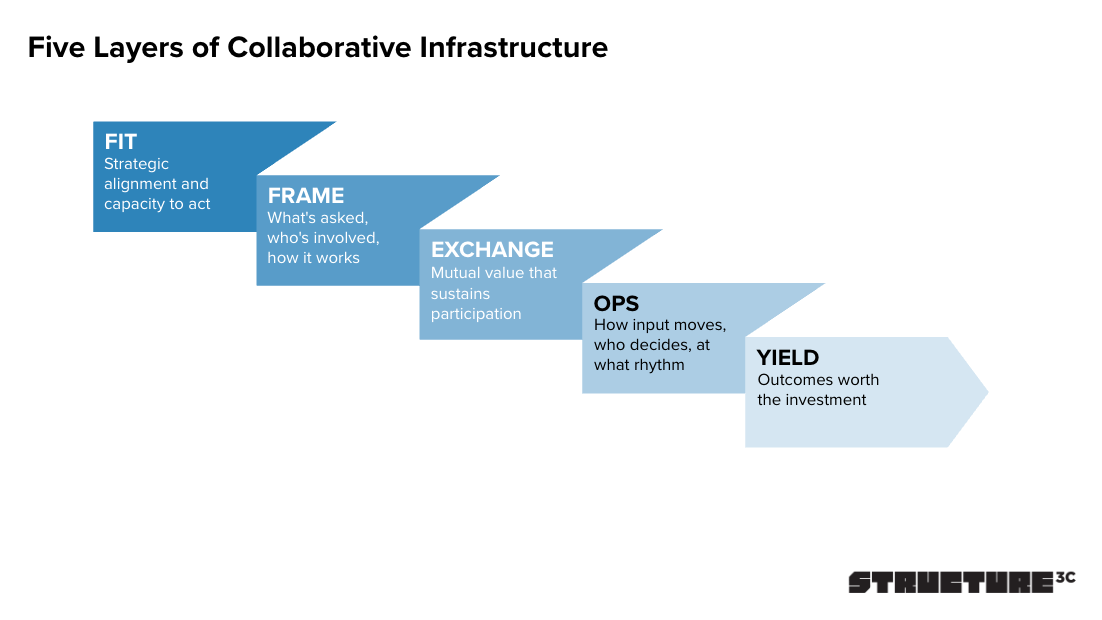
Fit: Should We Do This at All?
Most programs skip this layer entirely. Someone had an idea, found budget, and started building. The strategic rationale was later retrofitted, if at all.
Fit asks two things: Does this belong in our innovation portfolio? And can we actually absorb what we’d receive?
Different innovation objectives require fundamentally different approaches. Incremental improvement, adjacent expansion, and breakthrough innovation need different levels of openness, different participants, and different tolerance for ambiguity. Running a breakthrough problem through an incremental mechanism produces frustration on all sides. Meanwhile, who owns outcomes? What downstream resources are pre-committed? Who has the authority to actually approve, block, or act on what comes in? Programs don't fail from lack of ideas. They fail because no one inside is set up to do anything with them.
Frame: What Are We Actually Building?
Frame answers the structural questions. What are we asking people to do? Who participates? How will they engage? What are the rules?
Most of this comes down to specificity. Vague prompts produce vague submissions, then internal teams spend more time decoding what contributors meant than it would have taken to solve the problem themselves. Clear boundaries matter too. LEGO Ideas works because the boundary is obvious: fans design, LEGO manufactures. Quirky failed because the boundary blurred. (Try running injection mold tolerances past a thousand enthusiastic strangers.) The engagement format must match the purpose. Always-on platforms for continuous input. Time-bound challenges for focused problem-solving. Cohort programs for co-development. Live convenings for relationship-building. The failure is using one format for everything.
Exchange: Why Would the Right People Show Up?
If Fit and Frame are about organizational design, Exchange is about people. What makes the right participants contribute and stay engaged?
Every program needs a clear answer to: what do participants get that they can’t get elsewhere? Access to peers they wouldn’t otherwise meet. Influence on product direction. Early insight into strategy. Recognition. Compensation. “Exposure” is not a value proposition. Neither is “being part of a community.” The other structural failure is over-rewarding ideation and under-rewarding everything else. Testing, critique, documentation, synthesis... if you only celebrate idea generation, that’s all you’ll get. And passion will not compensate for structural extraction. At least not for long, and not from the people you most need.
Ops: How Does This Actually Run?
Ops is the least glamorous but most important layer. Where do contributions land, and who is accountable for doing something with them?
Salesforce’s IdeaExchange assigns product managers to specific categories. Ideas don’t land in a generic queue. They land with someone who has the authority to act. Adobe replaced its always-on platform with two focused cycles per year. Constraints create focus. The most important operational commitment is feedback. Not “thanks for your submission” but “here’s what we did with it, or here’s why we didn’t.” I’ve seen silence destroy more programs than any other single factor. And with AI now part of every conversation, you need to be explicit about what humans provide (judgment, context, novel framing) versus what AI contributes (synthesis, screening, pattern-matching). If you can’t articulate why you need humans in the loop, you’ll either waste their time or erode their trust.
Yield: Is This Actually Working?
Yield is the accountability layer. After all the design and operation, what did we actually get?
Implementation rate is one key indicator. Toyota’s famed internal suggestion system achieves 70% implementation, which is why it’s operated for decades while idea platforms come and go. If contributions aren’t being acted on, participants notice. They leave. Beyond implementation, connect participant input to actual business results: revenue generated, costs avoided, risks mitigated, time saved. This is harder than counting submissions, which is why most programs don’t do it. Institutional memory is also an asset. What does the organization retain if the program owner leaves? What do returning participants know that new ones don’t? If every engagement starts from zero, you’re not building infrastructure; you're really just running events.
Suggestions for Using the Framework
As a design sequence: Work through Fit → Frame → Exchange → Ops → Yield when building something new. Remember that each layer is dependent on the preceding layers.
As a diagnostic: Audit existing programs layer by layer. Most dysfunction stems from skipped layers, typically Fit (no strategic clarity) or Exchange (incentive mismatch). What looks like an engagement problem is often a Fit problem in disguise.
What’s Next
The next article in this series will introduce exercises designed to allow you to evaluate your programs with each layer of this framework. Test the framework in your own context before you commit real resources to it.
Most organizations already have the raw ingredients for collaborative innovation: Motivated customers, willing partners, and real problems worth solving together.
What's missing is the structure to make it work.
Interested in discussing collaborative innovation and how to build more value through customer relationships? Join Structure.Community. Next in-person event: February 25th, 2026, San Francisco.